Personal tools
You are here: Home » Fire Ecology and Policy » Post-Fire Logging

Post-Fire Logging

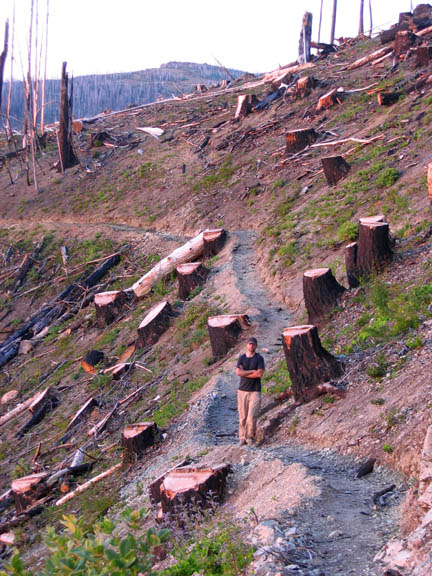
Post-Fire Logging on private land after the Quartz fire, southwest Oregon, 2002

Fire and other natural disturbances play critical roles in forest succession. Forests are adapted to fire, but they can be very sensitive and require time to naturally heal when burned. Federal land agencies and private timber companies often hasten to “salvage” log dead standing trees for their commodity value. Post-fire logging can increase fire hazard, disrupt ecological recovery, and harm water quality and wildlife.


POST-FIRE LOGGING INCREASES FIRE HAZARD


Post-fire logging extracts merchantable burned trees and leaves behind small trees with little commercial value. It relocates tree crown materials (tree tops, limbs, needles) to the soil surface, where it becomes available fuel for ignition. Relocating flammable biomass from the canopy to the ground changes the fuel complex and increases the immediate risk of a severe reburn. Oregon Dept. of Forestry records show that post-fire logging “slash” on land owned by Boise Corporation fueled a reburn after the 2002 Timbered Rock Fire.


The National Fire Danger Rating System rates heavy logging slash as the most dangerous fuel type when it is dry. Change in fuel loading resulting from post-fire logging can make direct attack of the next wildfire impossible under certain weather conditions, necessitating indirect suppression measures. This, in turn, increases the size and cost of wildfires. It also increases the likelihood of severe soil heating where post-fire logging occurs, and it threatens fire fighters and rural residences by making wildfires more erratic and difficult to control.


POST-FIRE LOGGING DISRUPTS ECOLOGICAL RECOVERY

Biscuit fire 2002, Indi timber sale cut 2004

Untreated logging slash can inhibit plant growth, and logging operations may virtually eliminate shrub species from a burned site. Inadequate shrub regeneration can lead to extinctions of species that restore soil productivity after fire. Furthermore, inhibited shrub regeneration precludes slope stabilization and results in greater soil erosion and increased sedimentation in streams than would occur in the absence of post-fire logging.


Loss of soil productivity is a costly impact because of its deleterious effect on nitrogen and carbon cycling and future forest growth. It takes decades or centuries for the ecosystem to replenish organic matter that otherwise would decompose into the soil. The effect of organic matter loss on long-term site productivity is not well understood for lack of research. However, land managers routinely ignore such uncertainties and unknown risks associated with post-fire resource extraction.


POST-FIRE LOGGING HARMS WILDLIFE


Burned forests provide attractive habitat for a distinct array of wildlife. Certain insects can be abundant in burned stands, which attracts insectivorous birds like woodpeckers. Changes in food composition and breeding habitat enable burned forests to support different bird communities from unburned forests, and many species depend on stand-replacement fires. To maintain healthy populations of these species over the landscape, burned patches of forest should be managed with great care.


Post-fire logging changes bird species composition, reflecting effects of large woody debris removal on foraging and nesting habitat of cavity nesters. For example, black-backed woodpecker and three-toed woodpecker have consistently shown negative responses to post-fire logging, with significantly more nests found in unlogged sites.


Learn More...

The first four links are related to the "Donato"  study published in the January 2006 Journal Science. The first link is a Brevia by Donato et. al., followed by Technical Comments by Newton et. al. and Baird, ending with a Technical Comment in response by Donato et. al.


Donato et. al., Post-Wildfire Logging Hinders Regeneration and Increases Fire Risk


Citing recent increases in wildfire activity in the United States and the intensified controversies surrounding the management of public forests after large fires, this paper published by Oregon State University Graduate students shares data collected in the 2002 Biscuit fire.


Newton et. al., Comment on ‘‘Post-Wildfire Logging Hinders Regeneration and Increases Fire Risk’’


Donato et al. (Brevia, 20 January 2006, p. 352) concluded that logging after wildfire kills natural

regeneration and increases fire risk. We argue that their paper lacks adequate context and

supporting information to be clearly interpreted by scientists, resource managers, policy-makers,

and the public.


Baird, Comment on ‘‘Post-Wildfire Logging Hinders Regeneration and Increases Fire Risk’’


Based on limited sampling 2 years after the 2002 Biscuit Fire in Oregon, Donato et al. (Brevia,

20 January 2006, p. 352) concluded that postfire logging reduced seedling regeneration by 71%.

Analysis of the study methodology and raw data suggest that this estimate is statistically flawed

and misleading and says nothing about the impacts of more prompt postfire harvest.


Donato et. al, Response to Comments on‘‘Post-Wildfire Logging Hinders Regeneration and Increases Fire Risk’’


We reported that postfire logging 2 to 3 years after the 2002 Biscuit Fire was associated with

significant mortality in natural conifer regeneration and elevated potential fire behavior in the

short term as a result of increased surface fuel loads. We underscore the strength of our study

design and statistical conclusions, provide additional details of the research setting and scope, and

address comments pertinent to forest development and fire ecology.


Wildfire and Salvage Logging: The Beschta Report


March 15, 1999

This paper offers a scientific framework of principles and practices that are provided to guide development of federal policy concerning wildfire and salvage logging and other postfire treatments.


Casualties of War: Environmental Impacts of Fire Fighting

by Timothy Ingalsbee, Ph.D., Western Fire Ecology Center

May 15, 1997

The war on wildfire remains widely popular with the public under the illusion that fighting fires "saves" forests from destruction. In reality, the Forest Service fights forest under the smokescreen of wildfires, and does so in order to log trees, not to save them.


Resources:


Beschta, R.L., C.A. Frissell, R. Gresswell, R. Hauer, J.R. Karr, G.W. Minshall, D.A. Perry and J.J. Rhodes. 1995. Wildfire and Salvage Logging: Recommendations for Ecologically Sound Post-Fire Salvage Logging and Other Post-Fire Treatments on Federal Lands in the West. Pacific Rivers Council. Eugene, OR. 14 pp.


Caton, E.L. 1996. Effects of Fire and Salvage Logging on the Cavity-Nesting Bird Community in Northwestern Montana. Ph.D. dissertation, Univ. of Montana. Missoula, MT. 115 pp.


Duncan, S. 2002. Postfire logging: is it beneficial to a forest? Science Findings (47). USDA Forest Service Pacific Northwest Research Station. Website: http://www.fs.fed.us/pnw


Hutto, R.L. 1995. Composition of bird communities following stand-replacing fires in northern Rocky Mountain (USA) conifer forests. Conservation Biology 9(5): 1041-1058.


Klock, G.O. 1975. Impact of five postfire salvage logging systems on soils and vegetation. Journal of Soil and Water Conservation 30(2): 78-81.


McIver, J.D. and L. Starr (eds.). 2000. Environmental effects of postfire logging: literature review and annotated bibliography. USDA Forest Service Pacific Northwest Research Station General Technical Report PNW-GTR-486. Portland, OR. 72 pp.


Saab, V. and J. Dudley. 1998. Responses of cavity-nesitng birds to stand-replacement fire and salvage logging in ponderosa pine/Douglas-fir forests of southwestern Idaho. USDA Forest Service Rocky Mountain Research Station Research Paper RMRS-RP-11. Ogden, UT. 17 pp.

Document Actions